


2Department of Cardiology, İzmir City Hospital, İzmir, Türkiye
3Department of Physical Medicine and Rehabilitation, Faculty of Medicine, University of Health Sciences, İzmir City Hospital, İzmir, Türkiye
Abstract
Background: To compare kinesiophobia, shoulder range of motion (ROM), functional disability, and handgrip strength (HGS) between patients with cardiac pacemakers and those with stable coronary artery disease (CAD).
Methods: This cross-sectional study enrolled 60 individuals aged ≥50 years with preserved left ventricular systolic function, including 30 patients with standard left-sided cardiac pacemakers and 30 individuals with CAD. Kinesiophobia was assessed using the validated Turkish version of the Tampa Scale for Kinesiophobia–Heart (TSK-Heart). Shoulder ROM, HGS, and upper limb function [quick disabilities of the arm, shoulder, and hand (QuickDASH)] were evaluated using standardized clinical protocols. Analysis of covariance was used for between-group comparisons.
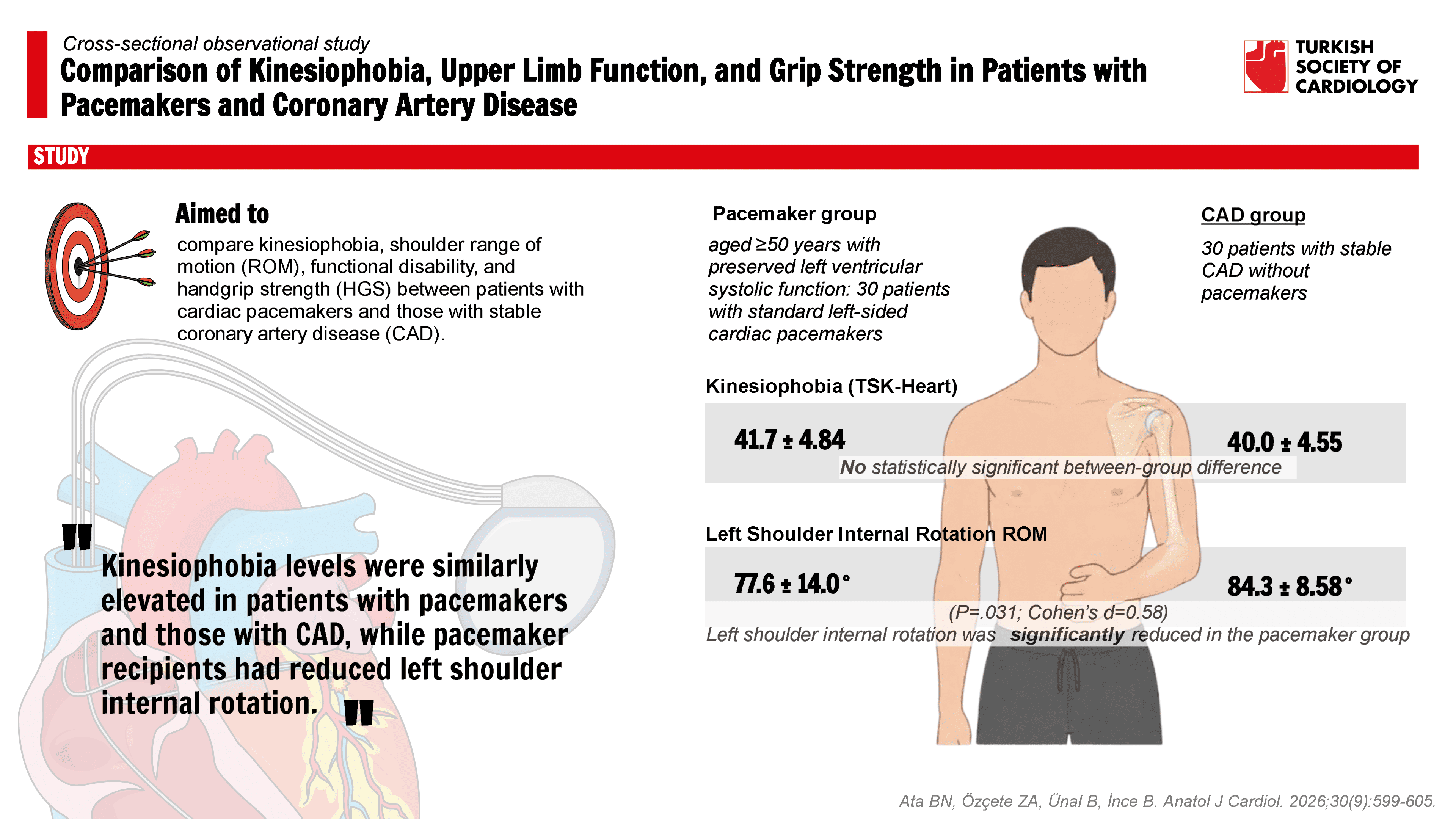
Results: The TSK-Heart scores were similar between the pacemaker and CAD groups, with no statistically significant difference (P = .061). Internal rotation of the left shoulder was significantly more limited in the pacemaker group (P = .031, Cohen’s d = 0.58). No significant differences were observed in other shoulder ROM parameters, QuickDASH scores, or HGS between the groups.
Conclusion: Kinesiophobia levels were similarly elevated in patients with pacemakers and those with CAD, suggesting that fear of movement is a generalized phenomenon across chronic cardiac populations rather than a device-specific issue. The selective internal rotation limitation observed exclusively in pacemaker recipients highlights the importance of targeted musculoskeletal assessment during clinical follow-up. Recognition of such functional impairments, alongside awareness of elevated kinesiophobia, is critical for comprehensive patient management.
Graphical Abstract
Highlights
- Kinesiophobia was similarly elevated in both patients with pacemakers and those with coronary artery disease.
- A selective limitation in shoulder internal rotation was observed among pacemaker recipients.
- Handgrip strength and self-reported upper limb function showed no significant group differences.
- Combining subjective scales and objective measures enhanced methodological validity.
- Findings suggest that kinesiophobia reflects a general cardiac response rather than device implantation.
Introduction
The annual incidence of permanent pacemaker implantation ranges from 260 to 469 per 100 000 individuals, a figure expected to rise further due to global population aging and expanding clinical indications.
Cardiac implantable electronic device implantation is considered a minor surgical procedure, but it carries risks, especially concerning musculoskeletal complications related to postoperative activity restrictions. Given that the pulse generator is positioned adjacent to the pectoralis major muscle, movements that engage this muscle can apply mechanical stress to the leads, increasing the risk of dislodgement, insulation failure, or fracture, particularly in the early post-implantation period.
Kinesiophobia refers to an excessive, irrational fear of physical activity, often linked to anticipated pain or risk of reinjury.
Handgrip strength, defined as the maximal isometric force generated by the muscles of the hand and forearm, is a clinically relevant biomarker of musculoskeletal function. Handgrip strength has a strong correlation with overall health status, and it predicts adverse outcomes more robustly than chronological age alone.
Despite growing interest in kinesiophobia and musculoskeletal function in cardiac populations, data regarding the interplay between pacemaker implantation, upper limb function, kinesiophobia, and HGS remain scarce. This study aims to elucidate these relationships to inform rehabilitation protocols and improve clinical outcomes in pacemaker recipients.
Methods
This cross-sectional observational study was conducted between September 2024 and February 2025. Written informed consent was obtained from all participants. The study protocol was approved by the institutional ethics committee (Decision No: 2024/68) and conducted in accordance with the ethical principles of the Declaration of Helsinki.
Participants with pacemakers had undergone implantation at least 6 months before enrollment. Participants were randomly selected among patients attending routine follow-up visits at a tertiary cardiology department of the hospital. A total of 60 patients aged ≥50 years with left ventricular ejection fraction >50% were enrolled. The sample comprised 30 individuals with pacemakers and 30 patients diagnosed as having CAD without pacemakers. To ensure inclusion of patients with at least moderate functional capacity, only those with a Duke Activity Status Index (DASI) score of 26 or higher were included. The DASI score is strongly correlated with functional performance and estimated peak oxygen consumption, making it a valid and practical tool for assessing aerobic capacity in clinical research.
Kinesiophobia was assessed using the Turkish version of the Tampa Scale for Kinesiophobia–Heart (TSK-Heart), which has demonstrated good validity and reliability in cardiac populations.
All patients underwent a standardized baseline evaluation conducted by a multidisciplinary team including a cardiologist and a physiatrist. All shoulder ROM and HGS measurements were performed by the same physiatrist to ensure consistency. Shoulder ROM was assessed with patients seated with their arms in a neutral position. Handgrip strength was measured using a Jamar hydraulic hand dynamometer (Sammons Preston, Inc., Bolingbrook, IL, USA) and recorded in kilograms. Participants were instructed to perform a maximal isometric contraction for 5 seconds with the elbow flexed at 90° and the forearm and wrist in a neutral position.
Upper limb function was assessed using the Turkish version of the Quick disabilities of the arm, shoulder, and hand (QuickDASH) questionnaire, a validated 11-item instrument that evaluates upper limb symptoms and functional status on a 5-point Likert scale, with higher scores indicating greater disability.
Statistical Analysis
All statistical analyses were performed using the SPSS version 25.0 statistics software package (IBM Corp., Armonk, NY, USA). Continuous variables are presented as mean ± SD. Categorical variables are reported as frequencies and percentages. Differences between categorical variables were assessed using Fisher’s exact test.
Age was included as a covariate in the outcome analyses because it significantly differed between the groups. To compare kinesiophobia scores between the groups, analysis of covariance (ANCOVA) was conducted. To assess whether there were differences in the ROM and functional scores of the left upper limb, a 2-way mixed-design ANCOVA was performed. This model included measurements from both the left and right shoulders of the same individual to reduce within-subject variability and enhance statistical power. In cases where a significant group × side interaction was found, differences in left upper limb function between groups were further explored using independent samples t-tests. For the analysis of grip strength, sex was included as an additional factor in the ANCOVA model. Additionally, due to the wide variability in pacemaker duration, subgroup analyses were performed. The pacemaker group was divided into 2 subgroups based on the median duration (23.5 months). Analysis of covariance analyses were repeated for the Tampa Scale, internal rotation, and QuickDASH scores across 3 groups: pacemaker duration ≤ 23.5 months, pacemaker duration > 23.5 months, and the control group. In cases where a significant group × side interaction was found, differences in left upper limb function between groups were further explored using one-way ANCOVA analysis.
Results
Sixty participants were enrolled and evenly allocated to the pacemaker group (n = 30) and the CAD group (n = 30). Of the total sample, 26 (43.3%) were female and 34 (56.7%) were male. Demographic comparisons revealed that the pacemaker group was significantly older than the CAD group (
For the primary outcome, no statistically significant difference was found in the ANCOVA analysis between the pacemaker and CAD groups in TSK-Heart scores,
Regarding secondary outcomes, a significant group × side interaction was found for shoulder internal rotation (
Discussion
This study aimed to compare kinesiophobia, shoulder ROM, functional disability, and HGS between patients with cardiac pacemakers and those with stable CAD. Kinesiophobia levels were similarly elevated in both groups, whereas only a selective limitation in shoulder internal rotation was observed between the groups. Although the pacemaker group was older than the CAD group, age was included as a covariate in all analyses. The persistence of selective internal rotation limitation after adjustment suggests that this finding is unlikely to be explained by age alone. Educational status also differed between groups; however, its independent effect on kinesiophobia or upper limb function was beyond the scope of this study.
The absence of a statistically significant difference in TSK-Heart scores between the pacemaker and CAD groups is noteworthy because both groups exhibited elevated levels of kinesiophobia. This finding was consistent with the meta-analysis by Liu et al,25 which demonstrated that kinesiophobia was prevalent across cardiac populations, including patients with CAD, heart failure, and atrial fibrillation, and with the study by Baykal Şahin et al,26 showing high baseline kinesiophobia in patients with CAD that improved after exercise-based rehabilitation. These findings suggest that elevated kinesiophobia reflects a general cardiac-related fear-avoidance response and highlight the importance of addressing kinesiophobia in both pacemaker and CAD populations, regardless of device implantation status.
The selective limitation of shoulder internal rotation observed in the pacemaker group represents a key finding of the present study. Due to the anatomic proximity of the pacemaker pocket to the subscapularis and pectoralis major muscles, internal rotation—predominantly mediated by these muscles—may be notably vulnerable to local fibrosis, increased soft tissue rigidity, and compensatory movement patterns post-implantation. In contrast, shoulder flexion and abduction can be more readily compensated by scapulothoracic motion and accessory musculature, potentially explaining their relative preservation. This finding partially aligns with reports describing impairments in flexion, abduction, and internal rotation, but conflicts with studies demonstrating either predominant limitations in flexion/abduction or no significant side-related ROM differences.
QuickDASH scores did not differ significantly between the pacemaker and control groups. This finding is consistent with reports showing no group-level differences between pacemaker recipients and healthy controls, but other studies have described mild or task-specific functional impairments in patients with more complex cardiac devices despite non-significant global QuickDASH scores.
Handgrip strength did not significantly differ between patients with cardiac pacemakers and those with CAD. This finding is consistent with studies reporting no marked reduction in HGS among older pacemaker recipients or patients with stable CAD and preserved cardiac function, despite its prognostic relevance when considered alongside frailty parameters.
A major strength of this study is its methodological rigor and strong internal validity. Almost all participants were right-hand-dominant and had standard left-sided pacemakers, and individuals with ICDs or CRTs were excluded, thereby minimizing confounding related to device type, implantation side, and limb dominance. The multidimensional assessment provides a comprehensive perspective on the musculoskeletal implications of pacemaker implantation and using patients with stable CAD as controls enables a clinically relevant comparison. To the best of current knowledge, this is the first comparative evaluation of kinesiophobia in pacemaker recipients.
Study Limitations
This study has several limitations. First, its cross-sectional design precludes causal inferences regarding the relationship between pacemaker implantation and upper limb dysfunction. Second, although group × side interaction effects were observed in secondary outcome analyses, the study was powered for the primary outcome (kinesiophobia) and may have been underpowered to detect small between-group differences in secondary outcomes (shoulder ROM, upper limb function, and HGS) as well as in exploratory subgroup analyses by pacemaker duration, which were additionally limited by small sample sizes within duration categories. Accordingly, non-significant findings in these outcomes should be interpreted with caution because they may reflect a potential Type II error. Moreover, advanced imaging modalities were not routinely performed to exclude subclinical shoulder pathology, which may have allowed occult abnormalities to remain undetected. Finally, the inclusion of only patients with preserved left ventricular systolic function may limit the generalizability of the findings.
Conclusion
Kinesiophobia was similarly elevated in pacemaker recipients and patients with CAD, suggesting a general cardiac-related response rather than being attributable to device implantation per se. Notably, the findings also point to a potential tendency toward reduced shoulder internal rotation in pacemaker recipients, reinforcing the value of early musculoskeletal assessment and patient education during routine follow-up. Longitudinal studies are warranted to clarify the persistence, determinants, and functional impact of these findings across stratified CIED populations.
Footnotes
References
- Bradshaw PJ, Stobie P, Knuiman MW, Briffa TG, Hobbs MST. Trends in the incidence and prevalence of cardiac pacemaker insertions in an ageing population. Open Heart. 2014;1(1):-.
- Şimşek EÇ, Uslu Güvendi E, Şimşek A. The Effect on upper extremity functions of cardiac electronic device placement on the dominant hand side. J Arrhythm. 2019;35(2):279-286.
- Findikoglu G, Yildiz BS, Sanlialp M. Limitation of motion and shoulder disabilities in patients with cardiac implantable electronic devices. Int J Rehabil Res. 2015;38(4):287-293.
- Toth P, Knecht J. Patient education guide. Nursing. 2004;34(1):46-47.
- Łuksza A, Świerżyńska E, Horbacewicz J. The simple is safe: leadless pacing in a patient after circulus vitiosus of complications and multiple cardiac surgical interventions. Anatol J Cardiol. 2023;27(12):5036-5037.
- Wood MA, Ellenbogen KA. Cardiac pacemakers from the patient’s perspective. Circulation. 2002;105(18):2136-2138.
- Aggarwal RK, Connelly DT, Ray SG, Ball J, Charles RG. Early complications of permanent pacemaker implantation: no difference between dual and single chamber systems. Heart. 1995;73(6):571-575.
- Miracapillo G, Costoli A, Addonisio L. Early mobilization after pacemaker implantation. J Cardiovasc Med. 2006;7(3):197-202.
- Struyf F, Meeus M. Current evidence on physical therapy in patients with adhesive capsulitis: what are we missing?. Clin Rheumatol. 2014;33(5):593-600.
- Kori SH, Miller RP, Todd DD. Kinesiophobia: A new view of chronic pain behavior. Pain Management. 1990;3():35-43..
- Roelofs J, Goubert L, Peters ML, Vlaeyen JWS, Crombez G. The Tampa Scale for Kinesiophobia: further examination of psychometric properties in patients with chronic low back pain and fibromyalgia. Eur J Pain. 2004;8(5):495-502.
- Bäck M, Lundberg M, Cider Å, Herlitz J, Jansson B. Relevance of kinesiophobia in relation to changes over time among patients after an acute coronary artery disease event. J Cardiopulm Rehabil Prev. 2018;38(4):224-230.
- Bäck M, Jansson B, Cider Ã, Herlitz J, Lundberg M. Validation of a questionnaire to detect kinesiophobia in patients with coronary artery disease. J Rehabil Med. 2012;44(4):363-369.
- Izawa KP, Watanabe S, Yokoyama H. Muscle strength in relation to disease severity in patients with congestive heart failure. Am J Phys Med Rehabil. 2007;86(11):893-900.
- McGrath R, Vincent BM, Peterson MD. Weakness may have a causal association with early mortality in older Americans: a matched cohort analysis. J Am Med Dir Assoc. 2020;21(5):621-626.e2.
- Leong DP, Teo KK, Rangarajan S. Prognostic value of grip strength: findings from the Prospective Urban Rural Epidemiology (PURE) study. Lancet. 2015;386(9990):266-273.
- Kim J. Handgrip strength to predict the risk of all-cause and premature mortality in Korean adults: a 10-year cohort study. Int J Environ Res Public Health. 2021;19(1):-.
- Wu Y, Wang W, Liu T, Zhang D. Association of grip strength with risk of all-cause mortality, cardiovascular diseases, and cancer in community-dwelling populations: a meta-analysis of prospective cohort studies. J Am Med Dir Assoc. 2017;18(6):551.e17-551.e35.
- Coutinho-Myrrha MA, Dias RC, Fernandes AA. Duke activity status index for cardiovascular diseases: validation of the Portuguese translation. Arq Bras Cardiol. 2014;102(4):383-390.
- Acar S, Savci S, Keskinoğlu P. Tampa Scale of Kinesiophobia for Heart Turkish Version Study: cross-cultural adaptation, exploratory factor analysis, and reliability. J Pain Res. 2016;9():445-451.
- Vlaeyen JWS, Kole-Snijders AMJ, Boeren RGB, van Eek H. Fear of movement/(re)injury in chronic low back pain and its relation to behavioral performance. Pain. 1995;62(3):363-372.
- Bäck M, Cider Å, Herlitz J, Lundberg M, Jansson B. Kinesiophobia mediates the influences on attendance at exercise-based cardiac rehabilitation in patients with coronary artery disease. Physiother Theory Pract. 2016;32(8):571-580.
- Roberts HC, Denison HJ, Martin HJ. A review of the measurement of grip strength in clinical and epidemiological studies: towards a standardized approach. Age Ageing. 2011;40(4):423-429.
- Mintken PE, Glynn P, Cleland JA. Psychometric properties of the shortened Disabilities of the Arm, Shoulder, and Hand Questionnaire (QuickDASH) and Numeric Pain Rating Scale in patients with shoulder pain. J Shoulder Elbow Surg. 2009;18(6):920-926.
- Liu L, Yang Q, Li T. Prevalence and influencing factors of kinesiophobia in patients with heart disease: a meta-analysis and systematic review. Sci Rep. 2024;14(1):-.
- Baykal Şahin H, Kalaycıoğlu E, Şahin M. The Effect of cardiac rehabilitation on kinesiophobia in patients with coronary artery disease. Turk J Phys Med Rehabil. 2021;67(2):203-210.
- Zhao W, Wang Q, Wang X, Ni X. The impact of nurse-led cardiac rehabilitation on physiological risk parameters: a systematic review and meta-analysis. Anatol J Cardiol. 2025;29(11):608-618.
- Cosgun MS, Cosgun C. Predictors of shoulder limitations and disability in patients with cardiac implantable electronic devices: importance of device size. Pacing Clin Electrophysiol. 2021;44(12):1979-1986.
- Cosgun C, Cosgun MS, Buyukturan O, Buyukturan B. Functional impact of cardiac implanted devices on ipsilateral shoulder range of motion, scapular mobility, and self-reported quality of life. PLoS One. 2023;18(4):-.
- Diemberger I, Pegreffi F, Mazzotti A. Implantation of cardioverter-defibrillator: effects on shoulder function. Int J Cardiol. 2013;168(1):294-299.
- Korte T, Jung W, Schlippert U. Prospective evaluation of shoulder-related problems in patients with pectoral cardioverter-defibrillator implantation. Am Heart J. 1998;135(4):577-583.
- Ozcan D, Balci K, Polat C, Ozcan O, Koseoglu B, Balci M. Shoulder problems and related conditions in patients with implantable cardioverter defibrillators. Ann Med Res. 2019;26(9):1861-1866.
- Surendran JP, Jacob P, Loureiro Diaz J, Selvamani DK, Mathew G, Swaminathan N. Optimizing recovery: a systematic scoping review of upper extremity exercise immediately after cardiac implantable electronic device implantation. Cardiology. 2025;150(1):36-47.
- Apaydin Z, Demir R, Mustafaoglu R, Sinan UY, Arabaci HO, Kucukoglu MS. Evaluation of upper extremity functional capacity and activities of daily living in patients with heart failure: a cross-sectional study. Heart Lung. 2024;68():316-322.
- Balla C, Passarini G, Bonsi B. Physical performance status predicts mortality in aging patients undergoing pacemaker implantation. J Cardiovasc Med (Hagerstown). 2021;22(10):738-743.
- Zhang F, Luo B, Bai Y, Zhang Y, Huang L, Lu W. Association of handgrip strength and risk of cardiovascular disease: a population-based cohort study. Aging Clin Exp Res. 2024;36(1):207-215.
- Wang Y, Pu X, Zhu Z, Sun W, Xue L, Ye J. Handgrip strength and the prognosis of patients with heart failure: a meta-analysis. Clin Cardiol. 2023;46(10):1173-1184.
- Parahiba SM, Spillere SR, Zuchinali P. Handgrip strength in patients with acute decompensated heart failure: accuracy as a predictor of malnutrition and prognostic value. Nutrition. 2021;91-92():-.